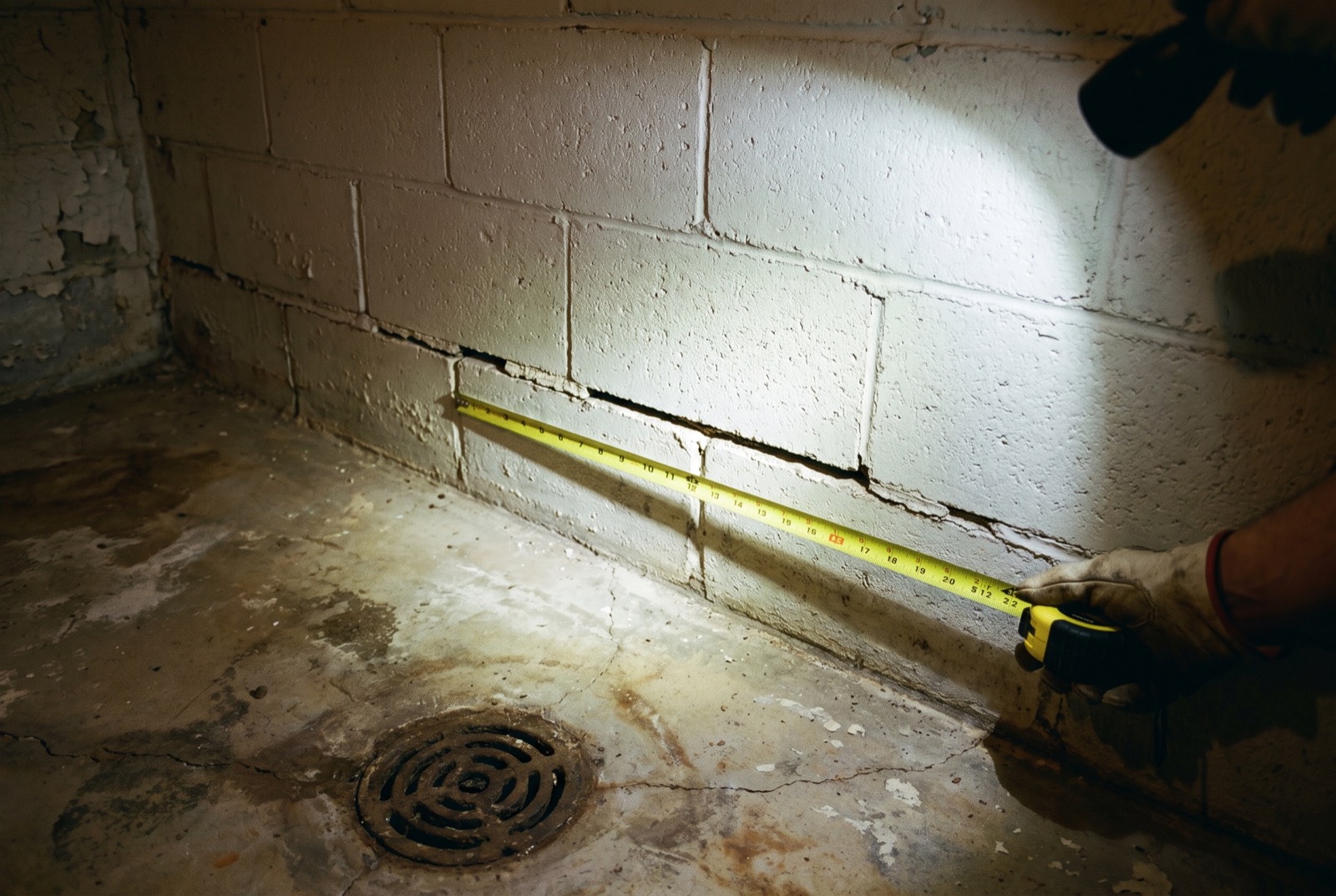
Why is my basement wall bowing inward?
Most of the time, soil outside the wall is pushing in harder than the wall can resist. Wet clay is heavy and expands, and block walls in particular do not handle sideways pressure well.
The right response depends on how far it has moved and whether it is still moving.
What are the signs of lateral pressure?
Look for these along the inside of the wall:
- A horizontal crack, often near the middle of the wall height.
- Stair-step cracks in block, running along the mortar joints toward the corners.
- The wall visibly curved when you sight along it, or leaning at the top.
- Gaps where the wall meets the floor slab or the framing above.
- Water or white mineral staining along the crack.
What causes the pressure?
Several things add load to a basement wall.
- Clay soil that swells when saturated and pushes on the wall.
- Poor drainage, such as downspouts that empty next to the foundation or ground that slopes toward the house.
- Heavy loads near the wall, like parked vehicles or a raised planting bed.
In the St. Louis area, expansive clay makes this a common problem, especially after a run of wet weather following a dry summer.
Can you measure whether it is getting worse?
You can monitor it. Mark the ends of a crack with a pencil and date it, or take photos beside a ruler every month or two. Measuring from a taut string to the wall at the same height can show whether the bow is changing.
Monitoring helps an engineer, but it does not replace an inspection. Do not try to push the wall back or add loads to it yourself.
What happens when an engineer looks at it?
We check how far the wall has moved, what is holding it up, the drainage around the house and the condition of the framing above. Then we explain what is happening in plain terms and what options exist. Sometimes the answer is better drainage and monitoring. Sometimes the wall needs reinforcement, designed and specified on paper so any contractor can bid on the same scope.
An engineer does not sell the repair, so the recommendation is not tied to a sale. See structural engineer vs foundation repair company for why that matters.
When should you call right away?
Stop and call if the wall has moved suddenly, if cracks are growing noticeably week to week, if the floor above is sagging or if the wall is leaning at the top. Keep people and storage away from that wall until it has been checked.
Our foundation inspection service covers exactly this situation. The fee depends on scope and is confirmed before the visit.
What should you send us?
Send the address and a few photos of the wall, the cracks and the outside ground along that wall. We reply within one business day.